Monday, November 27, 2006

Sensing activities in MUC

I have discussed before why conversation spaces are not places themselves, but rather for people to make places in them. In physical places as well as virtual ones, adaptation and appropriation of the associated technology by users is a critical element in the emergence of a sense of place and appropriate behavior. In short, the sense of place cannot be inherent in the system itself.

Within a place, social navigation is navigation through information collections on the basis of information derived from the activity of others. In the real world, we act where we are. We talk to people around us, because voices can only be heard at a short distance; we get closer to things to view them clearly. Understanding proximity helps us relate people to activities and to each other. When we see a group gathered around a meeting table, we understand something about this peoples' activity, and we know that another person standing off to one side is likely to be less involved.
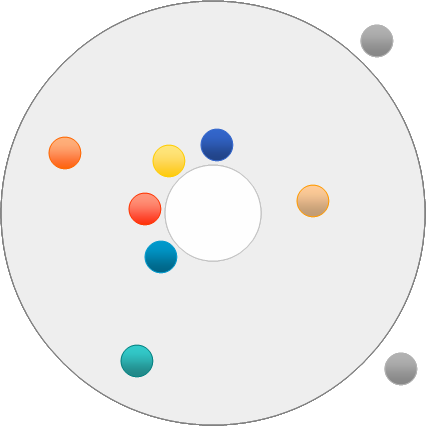
Just like in real life, place aware presence systems should allow users to move to areas where others are clustered, to join the crowd and see what's going on. Since actions and interactions fall off with distance, so distance can be used to partition activities and the extent of interaction. I have described here how the use of "social proxies" can be used as abstract artifact to induce additional social information. Amongst the "social proxies" that have been studied, I find the Bable experiments particularly interesting as it could be applied to multi user conversations, such as the MUC rooms available on many XMPP servers. The proxy's role is to provide cues about the presence and activity of participants in the current conversation. It is graphically represented by two concentric circles similar to the drawing herewith. The outer circle symbolizes the conversation room border, the inner circle the conversation subject. Every participant is represented by a colored dot. The way it works is that participants in a particular room are shown within the proxy outer circle. People in other rooms are positioned outside the circle. When people are active in the conversation, meaning they either "talk" or "listen", then their dots move towards the inner circle, and then gradually drift back out to the edge when their activity decreases. What is interesting is the way test users have reported their experience of using this type of proxy:

…our users report the social proxy is engaging and informative. They speak of seeing who is "in the room," noticing a crowd "gathering" or "dispersing," and seeing that people are "paying attention" to what they say (when other dots move into the center of the proxy after they post).
On the practical implementation side, XMPP provides a number of extensions that can be put to use to enhance existing MUC implementations to support this type of social proxy. Beyond the specificity of the social proxy, the expected enhancement falls under what I have been writing about as presence feedback.
  • XEP-0085 associated with message stanzas moving averages over time calculated at the MUC room level could provide sensible indications about the "talking" activity of every participant. A "listening" activity indication could be derived from the automatic presence status generated by the client.
  • XEP-0163 could be used at the MUC room level to notify the MUC clients of each participant's dots relative position changes to be displayed on the client interface. If we limit the proxy geometry to a Cartesian representation, we could easily derive an appropriate format for the associated data similar to the Geo Location XEP.
  • Other MUC rooms' global activity could also be provided to further accentuate the overall places context. Obviously, the notion of proximity could also be put to use to induce the notion of semantically related room discussion contexts.
In the end, I believe it is not overly difficult to assemble all these XMPP extensions together in a MUC implementation and, as a result, give a better sense of other people's presence and the ongoing awareness of activity into the conversation space. All in all it would be an interesting step toward better structuring our activity in the rooms, and better integrating communication and collaboration.

Technorati Tags: , , , ,

Labels: , ,

Sunday, November 26, 2006

Visibility, Awareness, and Accountability

I have already presented the concept of "social translucence" while discussing the benefit of adding "place" based information to presence for a better regulation of mediated communications. A "socially translucent" system enhances two important dimensions of communications. First, by making social information visible it enables participants to be aware of what is happening, and to be held accountable for their actions as a consequence of public knowledge of that awareness. Second, the fact that the real world is translucent to social information, and that people have a sophisticated understanding of the consequences of the visibility of their social interactions helps structuring interactions in a mediated communication.

While the "social translucence" perspective is unique, it is not the only concept to be concerned with making the activities of communication systems' users visible to others. Since ten years, a considerable research work has been targeted at video-mediated communication (Finn et al., 1997), and has led to the concept of "awareness". A number of researchers have constructed systems attempting in various ways to provide cues about the presence and activity of their users (Benford et al., 1994). These researches have highlighted three design approaches to representing social cues in a digital system: the realist, the mimetic, and the abstract.

  • The realist approach tries to project social information from the physical domain into or through the digital domain. This work is exemplified in teleconferencing systems and media space research.
  • The mimetic approach tries to reproduce social cues from the real world as literally as possible in the digital domain. The mimetic approach is exemplified by graphical games and virtual reality systems. It uses virtual environments and avatars to mimic the real world.
  • The abstract approach involves portraying social information in ways that are not closely tied to their physical analogs. It could uses abstract sonic cues to indicate social activity, or abstract visual representations. This approach also includes the use of text or simple graphics to convey social information.

Large deployment and adoption of systems based on the realist or mimetic approaches have faced substantial pragmatic hurdles, such as their cost, the required infrastructure, and the constraints of users support. On the other hand, I believe that the abstract approach has not received sufficient attention, particularly with respect to graphical representations. Text and simple graphics have many powerful characteristics: they are easy to produce and manipulate; they persist over time, leaving interpretable traces; and they enable the use of technologies such as search and visualization engines. In this last category we find "social proxies" such as those depicted here.

A social proxy is an abstract dynamic graphical representation that portrays socially salient information about the presence and activities of a group of people participating in an online interaction. It is one technique for providing online, multi-user systems with some of the cues so prevalent in the face to face world. Social proxies are intended to be visible to all those portrayed in them, thus providing a common ground from which users can draw inferences about other individuals, or the about the group as a whole.

Typically, a social proxy shows participants in a particular "place", as well as some of their activities in that "place". The choice of which aspects of activity are visible, and which remain private, depend on the particular context. Social proxies have four basic characteristics:

  • A social proxy typically consists of two components: a large geometric shape with an inside and an outside that represent the online "place", and much smaller shapes positioned relative to the larger shape that represent participants.
  • The presence and activities of participants in an online "place" are represented by the location and movement of the smaller shapes relative to the larger one. The relationships and movements of the visual elements have a metaphoric correspondence to the position and movement of peoples in a similar face-to-face situation.
  • Social proxies are public representations, and everyone looking at a social proxy for a given "place" sees the same thing. It is not possible for participants to customize their views of a social proxy. This is important because I know that if I see something in the social proxy all other participants can see it as well. This is what supports mutual awareness and accountability.
  • Social proxies are represented from a third-person perspective. Looking at a social proxy, every participant sees itself represented in it in the same way other participants are represented. This enables learning. A participant can see how its actions are reflected in its personal representation, and thus begin to make inferences about the activities of others.

The shared nature of a “social proxy” is critical. The knowledge that activity depicted in the social proxy is visible to all participants makes it “public”, and transforms it into a resource for the paticipants. It is this visibility that supports people accountability for their actions, and underlies the social phenomena, such as feelings of obligation, peer pressure, and imitation, that enable coherence in groups interactions.

On the Internet we are socially blind, and our attempts to communicate are often awkward. Even when others are clearly present, as in a chat room or on a conference call, it is difficult to see who is present, who is paying attention, or who wishes to speak. Things that require little effort in real world "places", such as taking turns when speaking; noticing when someone has a question; seeing who is responding to whom, require a lot of effort in online "places", when they at all are possible. I think introducing "social proxies" in widely used presence enabled applications, such as IM or VoIP clients, would allow us to progress on the way of a better sensitivity to the actions and interactions of those around us in virtual "places".

Technorati Tags: , , , ,

Labels: , , ,

Presence and going places

Mike Gotta has jotted down a series of notes about his trend of thoughts regarding presence technologies. In my opinion, his segmenting of the subject strongly reflects the constraints of an analyst work, but he nevertheless brings up many interesting points. I like in particular the way he widens up the scope of the reflection beyond current implementations

... food for thought and for consideration as to how some of these items relate to assumptions currently made around presence systems. How many assumptions based on instant messaging, IP telephony and so on will get in the way of a more expansive view of presence?

From his points, I would like to focus on presence relations to "location", "environment", "activity" and "role", what is often refered to as parts of a context. In that respect, because of their strong relationship to the physical reality, the use of spatial metaphors and spatial organization to model context have been favored by many mediated communication and collaboration systems. I believe this approach does not properly capture the complexity of real human social interactions. In real life, we are located in "space", but we act in "places". If the structure of a world is spatial, by comparison a “place” is a space invested with social meaning, such as behavioral appropriateness or cultural expectations. Furthermore "places" are valued "spaces". The distinction is like between house and home: a house is where we shelter, but a home is where we live. In order to get contextualy closer to the complexity of social communications, integrating “place” based information would greatly improve presence technologies.

Presence technologies make applications augments physical reality rather than replaces physical reality. Current implementations fall short in adapting to the vast variety of social communications contexts any human being is experiencing in real life. For example, the nature of relations and interactions with one's friends and family differs significantly from the nature of relations and interactions in the workplace. Even these simple differences are only superficially addressed by today's presence enabled applications. As a matter of illustration, we can cite:

  • The way of establishing trusted presence relations scales poorly. To establish individual full trust between 10 persons, 10×9/2=45 bilateral agreements need to be established. Trust groups would scale much better and be easier to manage.
  • The availability status does not provide much added value. Many community systems provide a list of who is on to the community website, using a group-based trust model where presence information not only indicates "who is online" but also "who is here". This model may work well when using a community’s website as primary shared resource. However, many groups and communities in workplaces often use a variety of shared resources. In such cases, for example when co-workers are always online at the same time, more detailed presence information than just online/offline status is needed.
  • The trust model is very crude. Either one establishes a trust relation and can always observe other's presence information, or one does not establish a trust relation, in which case one can never other's presence information and cannot engage in conversations. This might not be problematic when dealing with friends and family, with whom you expect to resolve unwanted interruptions easily. It becomes a problem when dealing with a larger set of co-workers in a multi-project environment.

Presence technologies need to be augmented to provide information not only about people but also about “places”. Unlike what is currently offered in IM and VoIP applications, more advanced presence mechanisms must allow exchange of information only with a certain subset of people, not always but sometimes only, depending on real-time context information that can be derived from the virtual or real “places” people visit. Today, ordinary presence systems only give answers about person oriented questions:

  • Who is online, or is this person online?
  • What is this person doing?

Advanced presence systems will have to provide answers and notifications about “place” oriented questions, such as:

  • Who is here?
  • Who is near?
  • Where is that person?
  • What is that person doing there?

It happens these questions can be answered by combining different scoped attributes of presence infomation, including the trust relation between parties, their real or virtual locations, activities at these locations and presence and awareness scopes.

Trust scope. Some presence systems allow anyone who has access to a presence server to see presence information of others, other systems are more restrictive. The establishment of trust is distinguished by four model aspects:

  • Opt-in / opt-out / managed: In an opt-in trust model, others can only see presence information if you explicitly give them permission. In an opt-out model, others can see presence information, unless you explicitly denied them permission. In a managed model, a third party instead of the users determines who can see presence information.
  • Individual / group: In a individual trust model, each person rights to presence information are managed separately. In a group trust model, rights to see presence information are managed for an entire group.
  • Reciprocal / non-reciprocal: In a reciprocal trust model, if A has the rights to presence information of B, then B also have the rights to the presence information of A. In a non-reciprocal trust model, this may not be the case.
  • Permanent / blockable / contextual: In a permanent trust model, presence information is available as long as the rights to do so exist. In a blockable trust model, presence information can temporarily be denied. If the rights to presence information are based on location or place the trust model is contextual.

Location scope and virtual distance. When users browse the web, edit files from a shared storage, or read or post in blogs, they are present at a "location" in cyberspace. That said, many characteristics of physical space, such as being aware of someone's presence, and being able to initiate contact and communicate with that person, do not necessarily exists in the cyberspace.
Location information is expressed by coordinates, but in cyberspace unlike in the real world, users can be at multiple coordinates simultaneously. Place-based presence systems need to answer the question "Who is near?", have to calculate virtual distance between these coordinates. Virtual distance is then used to determine who can and who cannot be seen. To calculate virtual distance, presence location coordinates need to be laid out in a space, such as topology, virtual world or any directed graph. In place-based presence systems, location information constitutes a primary form of presence information. Not only the fact that someone is online somewhere in cyberspace, but also which resource that person is accessing provides presence information that can be made available to trusted parties.

Presence scope. A presence scope specifies the maximum virtual distance at which a trusted party can watch presence information. One may use multiple presence scopes, e.g., "people on the same website can see me, but cannot see the page I am on" and "people on the same web page can see if I am focusing on that page".

Awareness Scope. An awareness scope specifies the maximum virtual distance at which a user wants to get notified of presence information of trusting parties. One may use multiple awareness scopes, e.g., "are there people with me on the same web page?" and "are people with me on the same web page focusing on the page?".

Activity scope. What a user is doing at a location is also presence information. For example, in addition to browsing a web page, this may involve whether the user is actually focusing on this page or not , whether the user is editing this page or not.

Ultimately, by relaying “place” based information, presence technologies will enable three important building blocks of social interaction-- visibility, awareness, and accountability-and thus become "socially translucent" systems. We can illustrate a "socially translucent" system by the following example. Consider a door with a design problem, which is likely to slam into anyone about to enter from the other direction when opened quickly. An attempt to fix this problem would be to place a "Please open slowly" sign on the door. As one might guess, the sign is not a particularly effective solution. But we could also put a glass window in the door. As people approach the door they see whether anyone is on the other side and, if so, they modulate their actions appropriately. The sign is no longer required. While this solution works, it is useful to examine the reasons for the effectiveness of the glass window:

  • Firstly, the glass window makes visible socially significant information. As humans, we notice and react to movement and human faces and figures more quickly than we notice and interpret a printed sign.
  • Secondly, the glass window supports awareness. One does not open the door quickly because one knows that someone is on the other side. Our social rules come into play to govern our actions, as we have been raised not to slam doors into other people.
  • Lastly, there is another subtler reason. Even if one does not care about hurting others, one will nevertheless open the door slowly because one knows that the other knows that one knows it is there, and therefore one will be held accountable for its actions. While awareness and accountability usually occur together in the physical world, they do not necessarily in a virtual context. It is through such individual feelings of accountability that norms, rules, and customs become effective social control mechanisms.

Note that "social translucence" is not only about acting according to social rules, but more about facilitating different types of communication and collaboration. Using presence information it is today possible to observe that another party is likely to be available for communication. In return for giving up some privacy, the other party expects to be contacted at suitable moments, can screen incoming messages, can plausibly deny being present by not responding or responding later, or simply by initiating the conversation at a time of its choosing. With "socially translucent" presence technologies it becomes easier for users to have coherent discussions, to observe and imitate others' actions, to engage in peer pressure, to create, notice, and conform to social conventions.

Technorati Tags: , , , ,

Labels: , , ,

Wednesday, November 22, 2006

Down with the phone number tyranny

Martin Geddes is the last amongst a long line of heroes before him to have a whack at killing the phone company. The phone company is like the fabulous Hydra of Lerna. For each of its head heads that is decapitated, another one or even two more spring forth. In addition, like the Hydra beast which is half snake, the phone company has a very long tail…

Besides the underlying saga, this post also join in the growing chorus advocating what Ken Camp summarize as
… presence and availability, or context, or whatever they become as facets of our digital identity and persona will be a huge piece of the evolution of unified communications.
Martin speaks of context as a driver for communication. I would say that context is the only driver of communication. We never communicate outside of a context, and whatever media we use must be able to take the context into account. But this has nothing to do with the technical context Martin describes. His context is just the mere legacy of the antiquated operating systems and user interface in use today. The context driving the communication is a temporal cross reference intersecting several social groups and encompassing one or several spatial environments. The post is interesting as it goes on trying to develop on concepts tightly related to presence technologies.

I like the way he describes how Outlook may look like if it were "socially" enabled, but I don't think he has grasped the full spread of presence technologies in upcoming communication systems. Describing an "address book" the way he does shows he simply did not take into account that the actual communication context is in effect part of one's own presence. So tomorrow's "address book" should only show what is relevant in this context.
There is another point where the post slightly misses the target. Or maybe this is a matter of wording. When talking of "collaborative" I am more inclined to use it in regards to inter-individuals collaboration, whereas Martin seems to emphasize the inter-applications collaboration. Beyond this semantic digression, I have previously described my frustration in front of current user interfaces, and this has since been further developed by Giacomo Vacca when he also deplores the crude state of these interfaces and says

It's not about how presence technologies provide information on users' availability, but rather how much presence information can be truly dynamic and reflect users' habits and personalities.
To illustrate my point, let's go back to the phone communication. The success of the phone lies in its ability to mediate the most important mean of communication common to any human being: voice. And voice has the intrinsic capability to convey intonations as well as articulated semantic meaning. As such, a voice communication system providing a decent sound quality will compete on fair ground with face-to-face communications where only sound is available. This quality makes the phone system unique, as it introduce almost no perturbation in the medium. And this quality also makes the phone system’s success. Every other means of communication introduce much higher perturbations in the medium.

I believe the phone is inexorably moving toward a wireless mobile device. This is a no return journey, and in a few years we won't see any fixed phone left. Hopefully, at the same time, the phone device interface would have evolved well beyond using

  • a touch tone keypad that was the ultimate invention in the early sixties
  • a display trying to simulate a miniature windowing system that became common in the early eighties.
Just look at all these poor mobile phone victims running in every airports' corridors, bent forward, pulling their roller bags with one hand while furiously thumb hammering their mobile phone with the other. Don't you feel they look strangely like the common representation of our Neanderthal cousins on the human evolution charts?

To conclude, I agree with Martin that we need to have a more integrated experience when we communicate, for the simple reason that technology should get out of the way. But, unfortunately, every example he gives still bears a strong influence from today's (or rather yesterday's) devices limitations. The most important of it being the use of phone numbers. The current phone devices are so closely associated with numbers that they are de-facto unfriendly to any other means of communication found on the Internet. A keyboard is already unfriendly, but a keyboard where you have to press three times the same key to obtain a single character is hundred times more unfriendly. We are so used to this approach for voice calls that we seem unable to think outside this limitation. See how Martin only describes "address books" as repertories for phone numbers…

Until the two words "phone" and "number" have been taken far apart, I believe we will unfortunately still see a lot of the phone company, both inside peoples’ minds and outside.

Technorati Tags: , , ,

Labels: ,

Monday, November 13, 2006

Of compartments and silos...

Brad Casemore presented earlier the upcoming integration of Yahoo! messenger into their mail service interface as

In another example of how online applications are becoming richer and more useful, Yahoo announced today that it will embed instant messaging into its web-based email program within the next few months, allowing  users to partake in live chats from Yahoo Mail and to obviate the need for installation of a desktop IM application.

I generally appreciate Brad's comments in the way they keep a positive tone. In this particular case, I am less incline than he is to only find positive aspects in this upcoming integration.  First of all, there is this persistence by one of the remaining consumer instant messaging incumbents to stick to proprietary protocols, rather than embracing open and documented standards. But more generally, as I pointed out earlier, I don't think Yahoo's current "me too" attitude is in any way giving a sign of "online application becoming richer and useful". If industry trend there is, it exemplify this industry inability in general, and of Yahoo! in this particular case, to properly grasp the current usage trends, and to provide relevant solutions to problems at hand.

Mike Gotta has perfectly analyzed the growing disaffection for email observed in "the current set of digital natives (those that have grown up using computers)". With the commoditization of tightly interwoven communication tools, the challenge of technology is not to offer a single command point trying to aggregate a "pot-pourri" of legacy and current communication channels, but rather to enable the proper use of the most appropriate channel and to move seamlessly between channels/devices at any time, while keeping the conversation active and rich.

I believe this is the kind of evolution we notice when we observe how teenagers prefer their IM client to an email client. But I would not qualify this of "generational". In my opinion, it results simply from a different "learning" context and different "social" priorities. The important point is that IM is nothing but another channel for communication, although more in line with the natural real-time nature of face-to-face communication than email in the current impersonation of online "social" spaces.
Looking at the upcoming UI mock-up, which does not provide the slightest hint of presence enabled contact list, makes me wonder if anyone at Yahoo! has even noticed that this evolution has already started. From the look of it and the justifications provided in the original announcement , email and IM are still living in far away silos at Yahoo! But can we really expect a walled garden proponent not to keep the few neurons at its disposal in separate cubicles?

As I hinted before, a true improvement would be to provide a generalized messaging interface, and leave the final routing decision to a combination of presence and user action. On the surface, one could argue that the proposed possibility of copying an email under redaction into an IM provides the same functionality. But this would be missing the true nature of asynchronous communication: it is a special case of synchronous communication, not the other way round. And to notice this subtle difference requires thinking out of the silos.

Technorati Tags: , , , ,

Labels: ,

Non verbal presence

I have reported earlier how different media type can affect the nature of peoples' interaction and by consequence influence the medium chosen by an individual who wishes to communicate. Many factors are affecting the level to which a medium is perceived as sociable, warm, sensitive, personal or intimate when it is used to interact with other people. Peoples in distributed environments are adjusting to perceived physical contact and closeness, even if it is not possible, just as people strive for intimacy equilibrium in the real world. They are also eager to retain the possibility of doing interactive acts in this environment, even if they would not do them due to social rules in the real world or the mediated context.
They will thus look for technical mediations involving impressions as much as they involve expression. For technologies that mediate presence, this mean:

  • Assisting the medium in its production of perception.
  • Minimizing the distortion or amplification of affective movements.
  • Allowing the user's action structuring.

I have previously presented views on how some form of feedback, when added to presence technologies, was desirable to minimize the intrusive nature of notifications and, by consequence, to limit some of the medium induced distortion. But I believe presence systems have a natural bias towards machine to machine communication, and most UI (user interface) still fall short at conveying non-verbal contextual cues. Although we find a host of presence attributes that can be aggregated and used to infer "enhanced" availability states, the available rendering techniques to assist the medium and enrich the user's perception of its environment still fall short of providing an adequate answer.

For example, in text based communication systems, commonly used UI substitutes for non-linguistic cues, such as gestures and facial expressions, are avatars, smileys and other fixed design elements. Clearly these "signs" have at best a reduced correlation to the user's intended meanings. And where a user's facial expressions are directly expressive, these are indirectly expressive. In particular, their appearance doesn't vary from user to user. Further more, they have to be interpreted in context. When a smiley used in an UI, the user has to resort not only to its knowledge of the author, but also to the context of email, IM, chat, or whatever communication tool is in use. In that respect, I don't agree with the argument that these design features enhance presence. They just slightly increase the palette of expressions, and minimally assist the medium in producing an impression.

I believe current human facing presence systems, although they like to qualify themselves of "enhanced" presence providers, still exhibits a very primitive capacity to render information about posture and non-verbal cues as they are perceived by the individual to be present in the medium. Maybe this is further amplified by the strong application (vs activity) oriented nature of today’s windowing UIs, and the difficulty many designers have to free themselves from "best practices" when these are nothing but entrenched habits. I think our UIs are showing their age and definitively lack the dynamic and ingredients necessary to the required production of perception.

Technorati Tags: , ,

Labels: ,

Wednesday, November 08, 2006

Morphing conversation UI

I am not a typical "example" when it comes to user interface, and I have my own idiosyncratic preferences, especially for communication applications. In particular, I despise the way we have been forced by the incumbent desktop software players to use mail clients to manage information. Their influence is so insidious, that even their strongest open-source contenders stick to the same screen real estate concept.

I came across this short post by Mike Gotta elaborating on the ineluctable death of the email client as we know it.

Concerning enterprise environments, at some point a few years down the road, shifting demographics as Danah Boyd points out in this post, will have an interesting impact on the future of e-mail clients. Once "digital natives" become a large part of the workforce, it's likely that we'll see a tipping point where users will prefer real-time communication front-ends to async front-ends. Yes, e-mail clients will support unified messaging and will morph to provide a real-time communication (RTC) user experience but younger workers may prefer to live in more natively-designed RTC clients (such as Microsoft Office Communicator and IBM Sametime), especially as those clients support both social and work-related capabilities.

I am a bit disappointed because my relief is not readily in sight, but this analysis is pre-announcing what I believe to be the irreversible evolution of our way to interact with desktop communicating applications. There was a not so distant time where the latest hipe was about getting IP to every workstation. The natural evolution would be to get conversations to the workstations, any type of conversation, and have all the associated communication stacks available as local servers to any application whishing to use them. At that point, it will become obvious that email is just an asynchronous channel for real time text exchange in a wide presence enabled communication system, instead of instant messaging being a real time version of email, as the current generation of "office" software would like us to believe. And I hope this difference will bring UIs more to my taste.

Technorati Tags: , , , ,

Labels: , ,

Wednesday, October 25, 2006

Seeing is not believing...

Announcements in the video-conference space have been flourishing lately. I find them interesting as they attempt to provide answers to the crude rendering of virtual conversation spaces when compared to the rich person-to-person interactions of real life.  A large telecom vendor has dubbed its system "Telepresence" and is pretending that

You can think of those technologies as precursors to true telepresence that replicates the experience of "being there".

Well, the advent of large flat screens technologies have certainly made it easier to cover an entire wall with screen panels, but the result remains far from the participants individual holographic representations in the Jedis meetings of "Star Wars"… In my opinion, these video-conference systems fall short in the way they provide view points, usually through a limited number of video cameras. And this latest offering of a well known software vendor claiming to provide

a 360-degree, panoramic video of side-by-side images of everyone who taking part in the conference.

will not make me change my opinion...

Real life shared conversation spaces allow people to maintain instant knowledge about others' interaction with the space. In a virtual world, the concept of conversation space awareness is key for systems wanting to approach the fluid interaction of face-to-face communication.
In physical conversation spaces, participants often shift their attention back and forth between individual and shared activity. In these moments, the space gathers lightweight information such as quick glances at another participant's or its personal area. This information participates in maintaining a sense of awareness of where other persons are and what they are doing. For example, in a work environment, this space awareness would help coordinate tasks and resources. People can use the space awareness to anticipate others' actions, help them with their tasks, and interpret references to objects in context.

Conversation space awareness comes naturally in a face-to-face communication, but it is far more difficult to render in real-time communication systems. In video-conference, only a fraction of the space may be seen, and each participant often does not see the same part as others. More generally, real-time communication systems reduce the richness of communication, and their user interface hides many actions that are visible in a real-life space. Moreover, the perceptual and physical abilities we use to maintain this awareness, such as glances, are replaced with mechanisms that are both slow and clumsy.

As I explained in a previous post, awareness is an essential component of presence. Designers of presence based systems will face two problems to integrate conversation space awareness. First, they will need to know what information should be captured about a person's interaction with the conversation space. Second, they will have to decide how this information should be presented to other participants.

The constituents of conversation space awareness fall into two groups. The first group concerns what is happening to participants:

  • Amount of activity (How active are the participants?)
  • Changes in progress (What changes are participants making?)
  • Expectations (What do participants need me to do next?)
  • Nature of actions (What are the participants doing?)

The second group deals with where it is happening in the space:

  • Focus (Where are the participants?)
  • Influence (Where can participants make changes?)
  • Objects in use (What objects are participants using?)
  • View extents (What can participants see?)

Setting explicit status in a presence system provides a first level of awareness. A second level of awareness can be inferred from events observed inside the conversation space, such as the visible or audible signs of interaction with the space or its artifacts, or the participants' activity behavior. But capturing intentionally public utterances, expressions, or gestures that are not explicitly directed at other participants may prove difficult.

In the end, even if a system integrates information from a variety of sensors and other sources, presence indicators still have a long way to go before they reflect true human nature. The “flat” implementations of today's user interfaces plays certainly in disfavor of a realistic rendering. And then there is the user behavior itself that comes into play. Just because my office's door is open and I happen to be looking outside, don't take it for granted you can come in and interrupt me.

Technorati Tags: , ,

Labels: ,